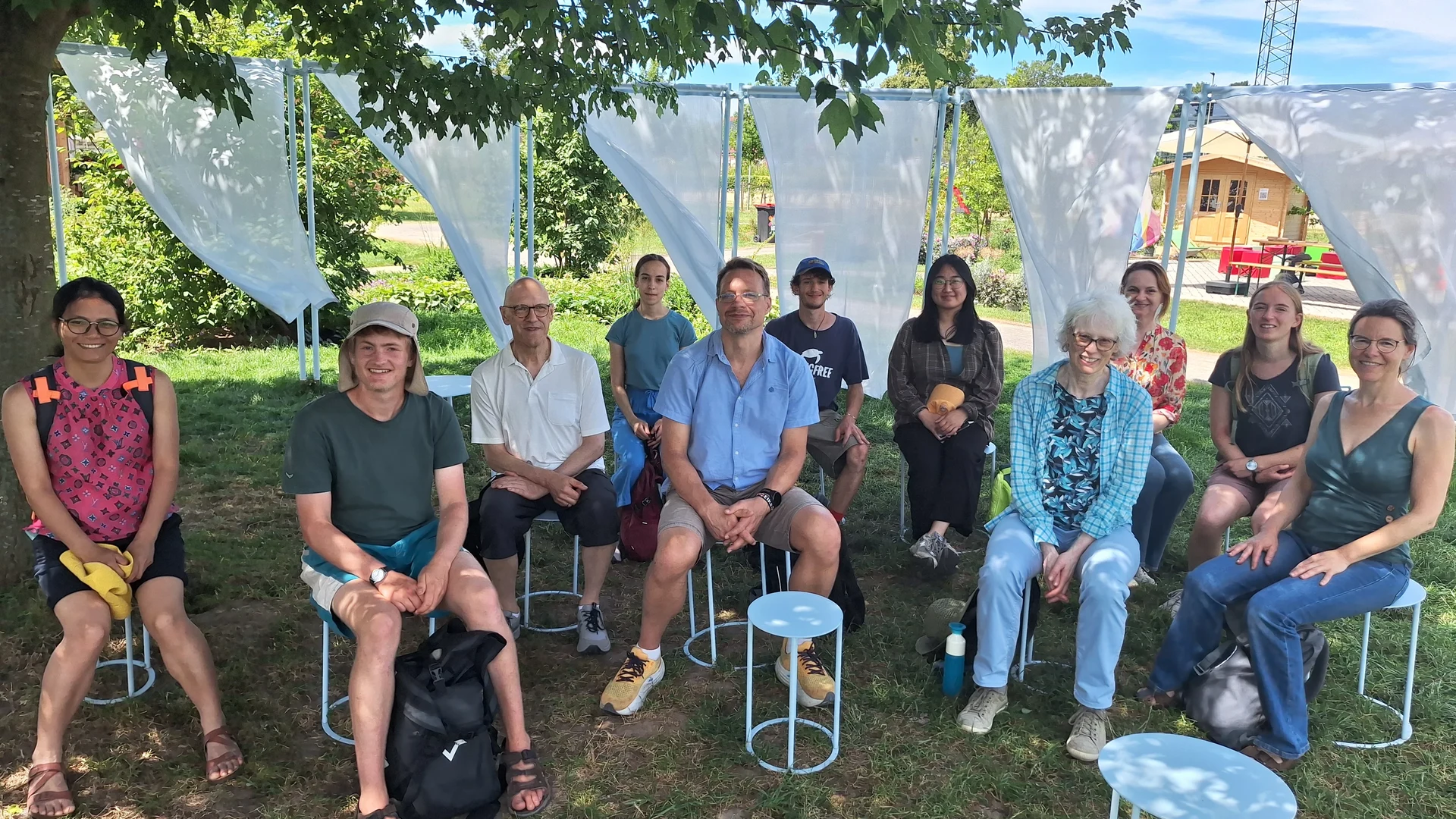
On June 29, 2026, a mixed group of students from the module “Praxis, Beratung und Innovationen im Gartenbau”, together with members of the HortiBonn staff, visited the Landesgartenschau in Neuss. The excursion offered a valuable opportunity to explore horticultural concepts and landscape architecture, while enjoying a day outdoors.
The journey to Neuss went smoothly, and we arrived by train without any complications. On our way from the station to the exhibition grounds, Simone, a native of Neuss, guided us through parts of the city and pointed out several local landmarks. Among the highlights were the historic harbor cranes along the waterfront, which provided a glimpse into the city’s industrial heritage.
The Landesgartenschau site itself was created on the grounds of a former horse racing track. To reach our guided tour, we crossed the entire exhibition area from the West Entrance to the East Entrance, allowing us to gain a first impression of the vast and diverse grounds. Along the way, visitors could already appreciate the combination of horticultural displays, artistic installations, and recreational spaces that characterize the event.
Our guided tour began in the “Gartenland” section, where we visited a variety of show gardens. Many of the gardens featured integrated pools and water elements that looked especially inviting on the warm summer day. While several of us were tempted to cool our feet in the water, signs throughout the exhibition clearly stated that bathing was prohibited.
The show gardens offered plenty of inspiration and featured a wide range of interesting plants, creative planting schemes, and innovative design ideas. At the same time, some of the layouts sparked lively discussions within our group, leading to occasional questions about the intentions behind certain planning and design decisions. These conversations highlighted the importance of critical observation when evaluating landscape and garden concepts.
After exploring the show gardens, we moved on to the agriculture section of the exhibition. Many participants were eager to spend more time observing the chickens on display, but our schedule required us to continue to several other attractions. Among these was a small agrivoltaic (Agri-PV) installation, where solar panels were combined with berry production, demonstrating how renewable energy generation and agriculture can coexist on the same land.
Nearby, we visited an art installation created by the local women farmers’ association (Landfrauen), which showcased the connection between rural life, agriculture, and community engagement. From there, we continued to an exhibition area dedicated to the renaturation of gravel gardens, presenting alternatives that promote biodiversity and ecological value in urban and private landscapes.
Another memorable stop was the artwork “Wir treffen uns im Wind” (“We Meet in the Wind”) by Japanese artist Hayato Mizutani. The final destination of our guided visit was the Schützenhaus, a building supported by living trees. This remarkable architectural concept demonstrated how buildings and natural elements can be integrated in innovative and sustainable ways, but also raised critical discussions if the trees suffer under the construction and how old such a building may get.
The excursion to the Landesgartenschau Neuss 2026 provided numerous insights into contemporary horticulture, landscape design, agriculture, sustainability, and environmental art. Beyond the educational value, the trip also offered an excellent opportunity for students and staff to exchange ideas, discuss observations, and enjoy a day of learning together in an inspiring setting.
