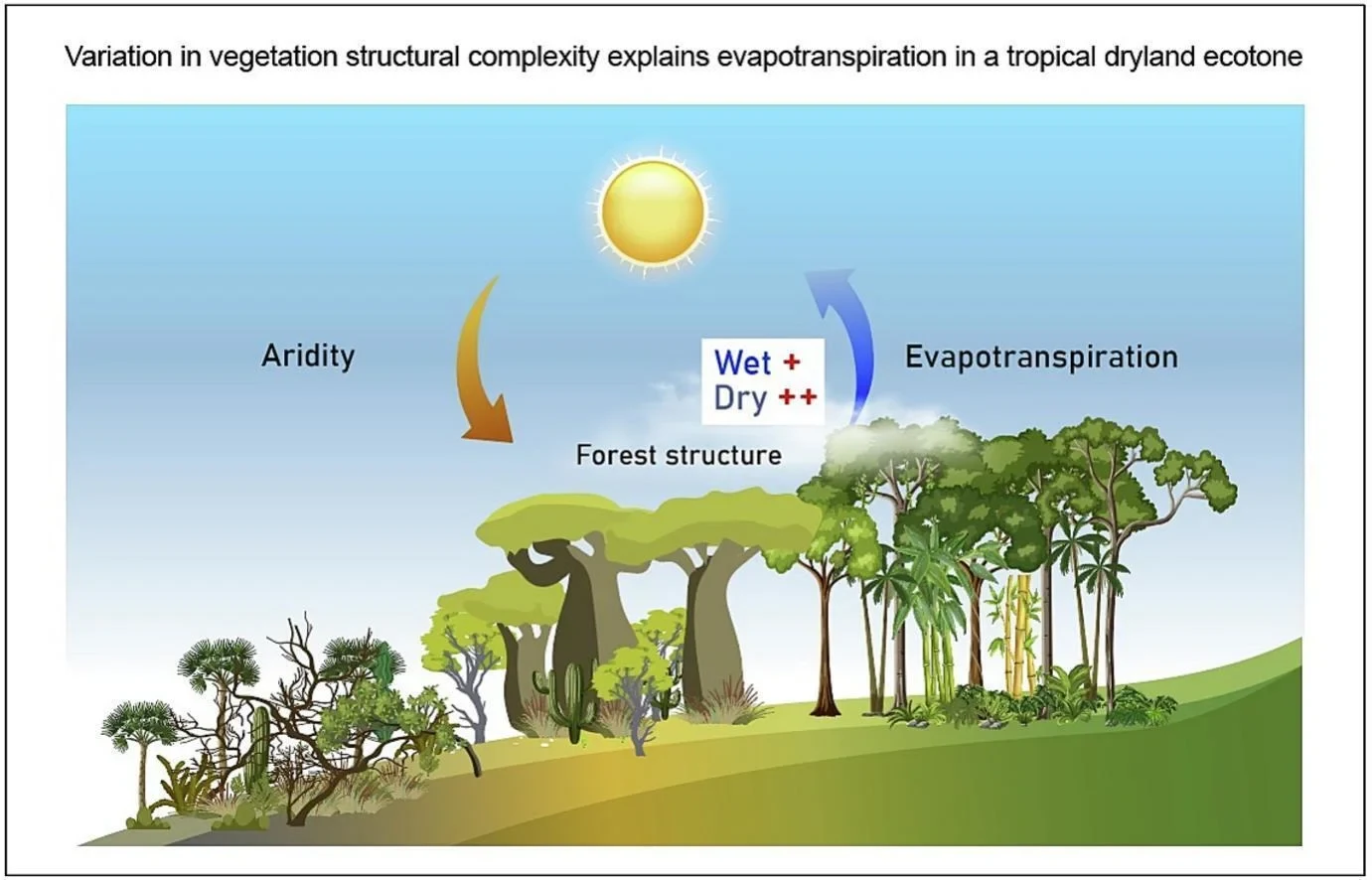
In natural drylands, the spatial distribution of vegetation characteristics is shaped by environmental conditions, with aridity being a key factor. However, the extent to which variations in vegetation characteristics affect vegetation-atmosphere fluxes through actual evapotranspiration or through the ratio of actual to potential evapotranspiration (ETa/ETp) remains less clear. In a dryland ecotone in western Ecuador’s lowlands, characterized by a 210-day dry season, an interdisciplinary team led by the University of Göttingen assessed 3D vegetation structure using a ground-based mobile laser scanner on 75 plots across different forest types (xerophytic forest, dry forest, and evergreen forest) during both, wet and dry seasons. Our findings reveal that differences in vegetation structure, particularly as measured by Db, significantly contribute to explaining spatial variation in ETa and ETa/ETp, especially during the dry season. We suggest that dry-season aridity likely drives adaptations in vegetation structure that reduce ecosystem evapotranspiration. By utilizing high-resolution 3D vegetation structure data, we can better understand the intricate relationship between forest structure and land–atmosphere feedback. Our findings emphasize the importance of preserving the complex structural diversity of dryland ecosystems to ensure their continued functionality.
Reference: Valdés-Uribe, A., Hölscher, D., Röll, A., Seidel, D. (2025). Variation in vegetation structural complexity explains evapotranspiration in a tropical dryland ecotone. Ecological Indicators, 181, 14433. https://doi.org/10.1016/j.ecolind.2025.114433